
Franklin County Arrest Log Availability
The Franklin County Sheriff's Office posts no official 72-hour, weekly, or other multi-day booking log on its website. Its news page carries announcements, not a rolling roster. The detention-complex page names no bookings. That leaves no verified window, rollover rule, field set, photo policy, update cadence, or online archive depth to describe.
A missing blotter does not mean the records are gone. FCSO may hold a booking or arrest record. A municipal police department may hold the incident report. The Franklin County Clerk may hold the case file. Each answers a different question. Detention status shows whether someone is held locally, a police report covers an agency event, and a court file tracks the case once charges are filed.
The official FCSO news page shows how agency news differs from a named arrest log.
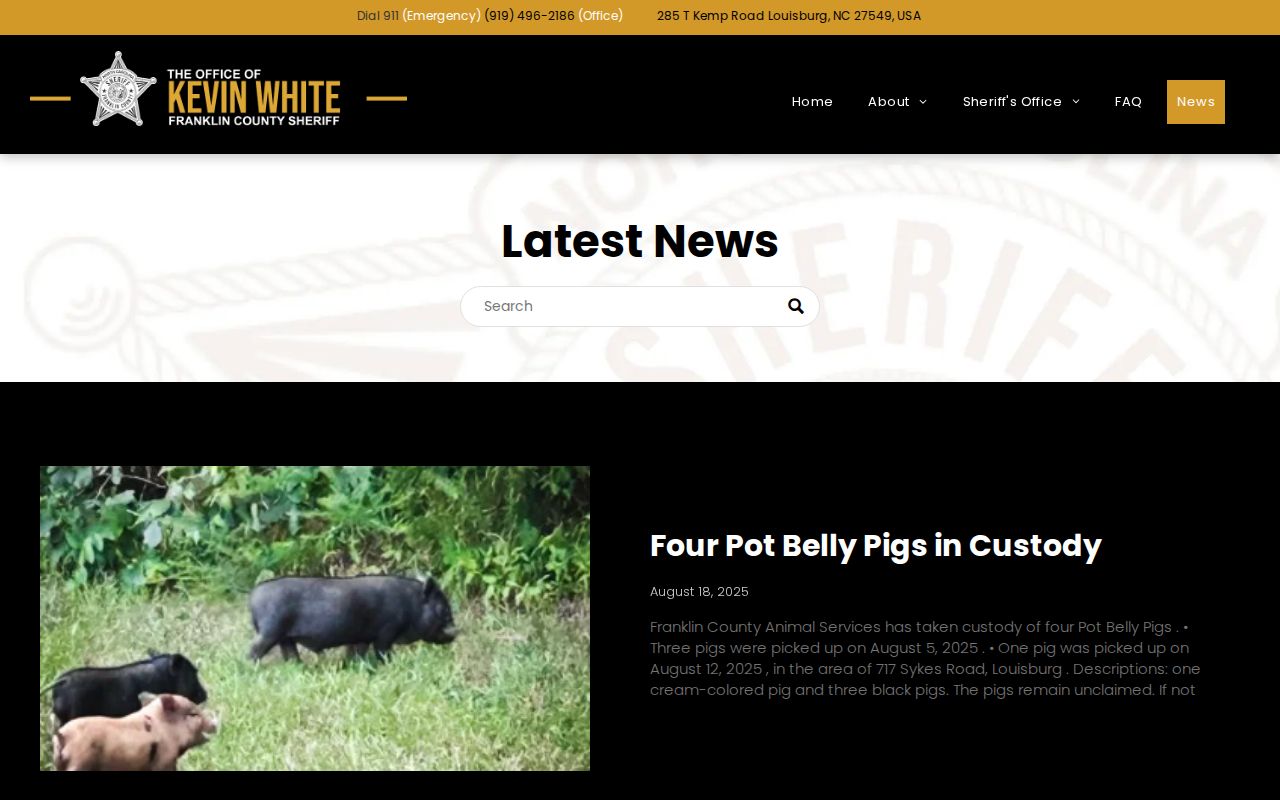
Announcements may cover selected cases, yet the page is no complete multi-day booking record.
Read Franklin County Blotter Sources
Start any multi-day search with dates. Pick an arrest-date range and place the event in Louisburg, Franklinton, Youngsville, or rural Franklin County. Then pin down the arresting agency. FCSO and the municipal departments keep separate records. County dispatch connects several agencies, and the Franklin County Detention Complex serves as the central county custody point.
- Search the official agency's news or records channel for the chosen period, without treating silence as proof of no arrest.
- Ask FCSO for a booking or arrest record when the person entered county detention.
- Ask the arresting city police department for its incident or arrest report when a municipal officer handled the event.
- Search NC eCourts by name or case number to trace public court events and later disposition.
- For dates beyond an agency's current files, ask which record series and retention rule applies before contacting the State Archives.
Keep the source date and the event date apart. A Thursday story may describe an earlier arrest. A court event can post after release, and an unofficial page may keep an entry long after local custody ends. The 24 Hour Arrests page takes a different approach to a very recent possible booking.
Franklin Arrest-Log Fields Explained
There is no live county interface to copy field names from. What follows is an inventory of what a careful request should seek. It draws on North Carolina public arrest categories. It also uses the approved sheriff-records schedule. Availability still depends on the record, the custodian, and lawful limits.
| Log detail | How to use it |
|---|---|
| Name or alias | Confirm identity with more than a name alone |
| Arrest date and time | Separate the event from booking or publication dates |
| Location and agency | Identify the correct police or sheriff record holder |
| Alleged violation | Read as the charge reported at arrest, not a conviction |
| Booking reference | Use if released by FCSO to narrow a records request |
| Custody or release status | Verify directly because an old log cannot prove current custody |
| Court case and disposition | Use clerk or eCourts records for the later outcome |
| Booking photograph | Ask the custodian whether one exists and is releasable |
North Carolina G.S. 132-1.4 separates public arrest information from criminal investigative material. The State Archives schedule lists richer possible arrest-report fields. A schedule is no promise, though. Not every field appears in every record. Juvenile and protected material must never be treated as adult public blotter content.
Louisburg Reports Are Aggregate
Louisburg offers a useful local distinction. Monthly police activity material in town council packets can count enforcement work. It does so without naming each arrested person. The August 13, 2024 agenda packet reports July activity. Separate categories cover “Arrest,” “Arrest (Citation/Summons),” and “Arrest (WS).” The October 8, 2024 packet covers September activity in the same administrative setting.
Those categories are not a booking feed. A citation or summons may never lead to county jail intake. “WS” is an activity category. It is not a list of warrants or detained people. The packets say nothing about booking-photo fields, named records, or present custody. They are useful for agency workload and broad enforcement patterns. An individual lookup still takes the police report, the FCSO booking record, and the court file.
The Louisburg Town Council archive is the official source for agenda material. Search the right month's packet and note the report period. Never turn aggregate counts into claims about individuals.
Note: An enforcement count measures recorded activity, while a jail blotter would identify individual booking events across a set window.
Franklin News Is Selective
The Franklin Times is a local weekly newspaper based in Louisburg. It publishes news and community stories, offers article search, and keeps past issues. The paper carries no routine named booking blotter or official mugshot gallery. A reported arrest may run days after the booking date. Many arrests get no story at all. Check article sourcing case by case.
Treat the newspaper as a step after official channels. Its article search can help locate a dated story. Coverage reaches Franklin County, Louisburg, Franklinton, Youngsville, Bunn, and rural areas. Match the story's named agency against FCSO. Then check the date against the relevant police department and the court record. A photograph in a news article is not proof of a current booking-photo policy.
The Franklin Times home page shows its story-based structure.

County news coverage adds context, but it cannot stand in for a complete official arrest log. The Franklin Times search screen offers another way to locate older coverage.
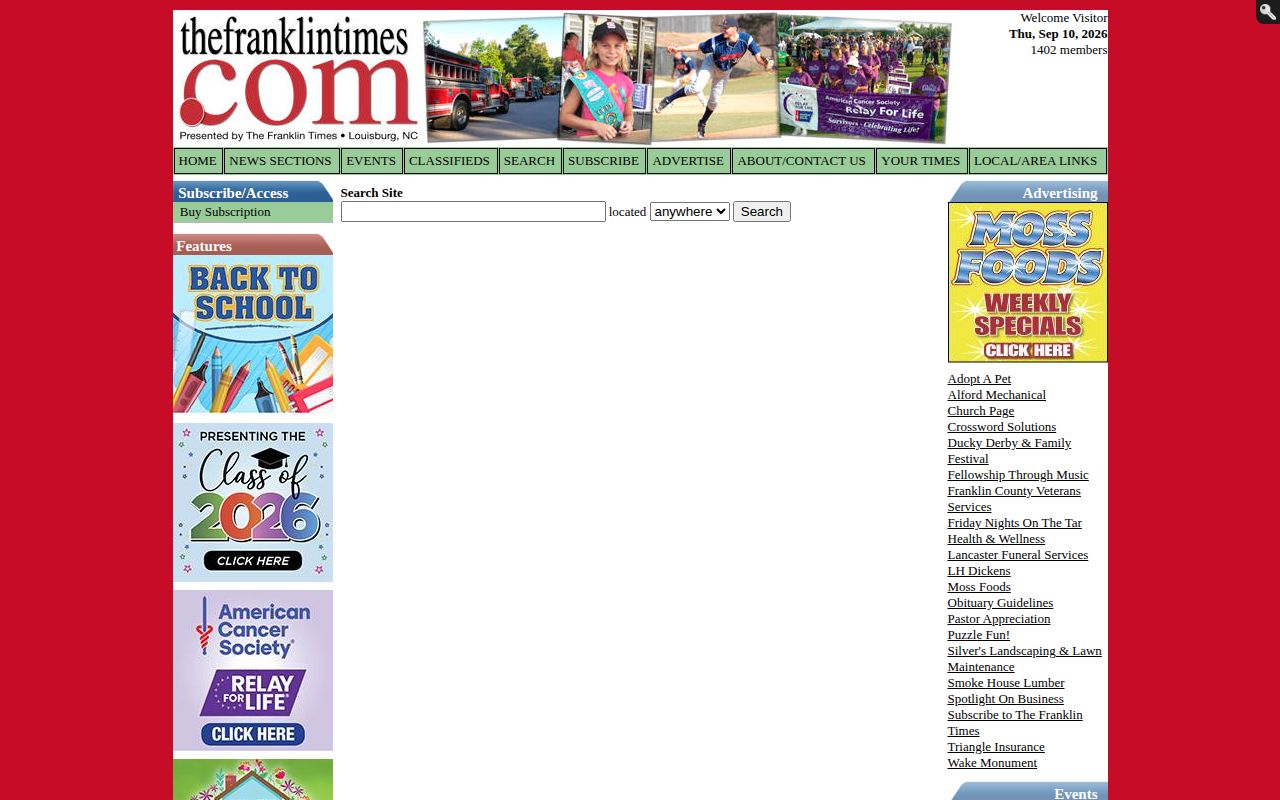
Search by name, place, and date range, then verify any match with the originating agency and the court.
Unofficial Franklin Arrest Archives
A few commercial sites hold Franklin County arrest pages. Busted Newspaper and Mugshots.com both keep county categories. Neither answers to the sheriff's office. Entries there can sit for weeks, repeat old bookings, or carry plain errors, and coverage is spotty. No secondary site proves full reach across Louisburg, Franklinton, Youngsville, Bunn, or the county detention complex. A few others deserve caution. RecentlyBooked lists no live Franklin local page, Arrests.org shows only a statewide interface, and Mugshots.zone routes can land you in the wrong state entirely.
So put official sources first. Treat an unofficial hit as nothing more than a lead toward a date, agency, or identifier you can take to the sheriff. Never infer present custody, bond, a federal hold, or a court outcome from a photo or a stale entry. JailExchange's Franklin facility page falls in the same bucket: general directory advice rather than a verified county feed.
Request Older Franklin Arrest Records
For records that never hit the web, go formal. The county's Public Records Request page routes police-report requests to the sheriff and general requests to Records(at)franklincountync.gov. Name the person, the approximate arrest date, the place, the agency, and the exact record series. Ask for a booking sheet, an arrest report, or a releasable photograph. A vague request for "all arrests" slows everything down.
Retention rules matter here. The State Archives sheriff schedule allows arrest-processing tracking records to be destroyed one year after the arrest. Standalone arrest reports may go at five years. Solved felony case histories carry a 20-year period. Solved misdemeanor histories run three years. Unsolved files wait until solved, then run their period. Audits, litigation, or open investigations can hold a file longer.
Retention still does not mean online visibility. An old arrest file may sit at the sheriff's office and never transfer anywhere. Start there. If staff report a transfer, turn to the State Archives county records guide with Franklin County, the agency, the record series, the date range, and any case number in hand. Historical newspaper pages may survive on a separate schedule.
Court records are the last stop. The Franklin County Clerk or the NC eCourts Portal holds the judicial file, and only that file shows a dismissal, plea, amended charge, or judgment once the booking log has captured the early arrest.
Note: Never present an old archive entry as a current custody record or a historic photograph as a current booking image.